
Grief is not linear. I think that is a saying most people are familiar with. But what does that actually mean? What does it look like? It looks different for everybody.
I’ve heard references to the stages of grief before, but I never knew exactly how to pinpoint what they were. I decided to find out about the different stages of grief. I discovered the stages were identified in the late 60’s by Elizabeth Kubler-Ross. The idea of the different stages can be graphed into what they call the Kubler-Ross Change Curve®. This curve can apply to any type of loss. The development of the stages or the curve is just another way to help us understand the emotions around loss and attempt to cope with them. However, even with this model, emotions take up too much space to be put in a box, and not every stage aligns perfectly with how someone may actually feel. Hell, you might not even be able to put a name to what you feel at any given moment. And that is okay. You don’t have to know what the stages are to experience your personal journey through them.
Kubler-Ross identifies the stages as:
- Shock and Denial often characterize early reactions, as individuals absorb new realities and begin to process their implications.
- Anger and Frustration may arise as awareness deepens and the challenges of adjustment become clearer.
- Bargaining and Reflection frequently accompany efforts to regain stability, control, or meaning.
- Depression or Sadness may emerge as losses are more fully recognized and integrated emotionally.
- Acceptance and Integration reflect growing adaptation as individuals begin to incorporate change into daily life.
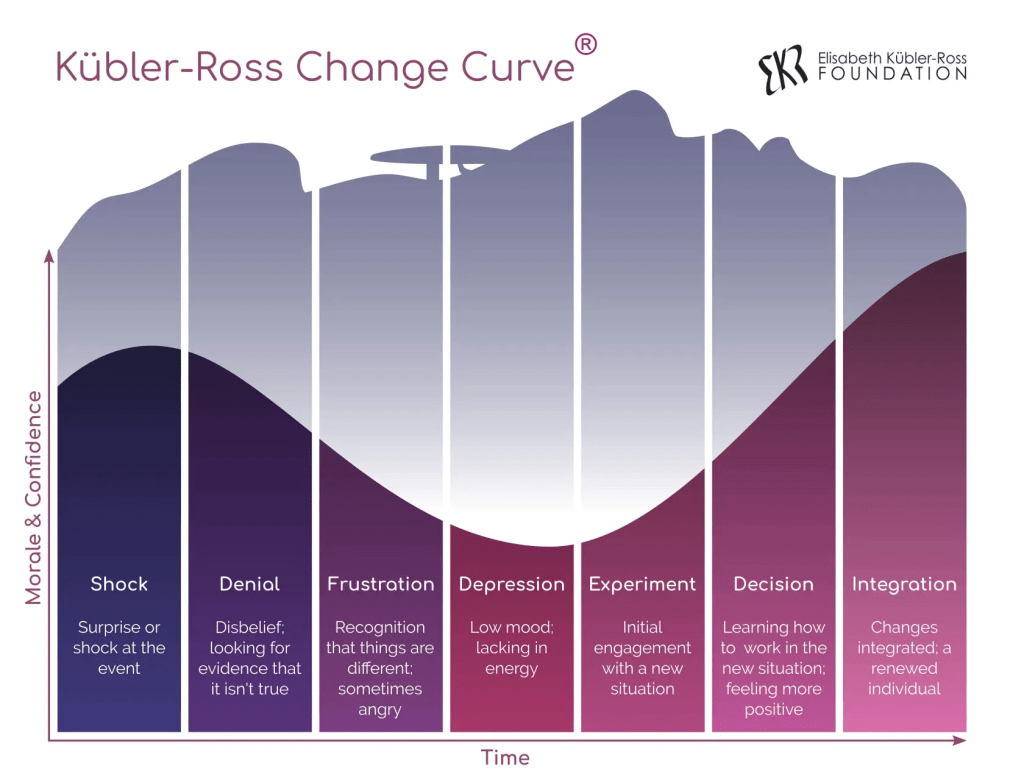
What I found interesting is that, while my own emotions were hard to place at times, I can associate some of my experiences to this curve of emotions.
When I decided to finally get a divorce, I was fed up. I wasn’t in denial—I had been in denial most of my marriage. I wasn’t in shock, because I was the one who decided to divorce him. I knew it was coming – there was no surprise. I can fit the feeling of being at the end of my rope into the anger category. I was frustrated that I’d taken so long to recognize my worth. I was furious with how hard it was to just leave his presence. I couldn’t buy a house at the time because I was in a state of limbo with the divorce looming over my head. I couldn’t even rent a home. I was enraged that my only options were to live with him in that house or spend money on a hotel. I chose the hotel.
If at any point after I filed for divorce, or even within the first year after, I was in denial, it wasn’t me wanting to rekindle our relationship (this time); it was in my lust for him. I couldn’t quell those emotions so easily. Oftentimes in our relationship, the arguments and screaming matches led to passionate, intimate moments. The intimacy acted as a resolution. In my agitation with the situation, the familiar itch of wanting to feel his body on mine to fix it took over. Realistically, I still wanted him to want me. That desire was magnified, and we acted on it. Several times. Something very normal to do, by the way (notice I didn’t say healthy). I was in denial, thinking that wouldn’t complicate the situation, that I could keep my emotions in check. Bet you can guess how that turned out.
After the papers were signed, I fell into depression. I didn’t want to leave the house. I didn’t have the capacity to do anything but work, eat, and binge-watch TV shows and movies. Sometimes I would stare out of the large window of my very expensive apartment, wallowing in hopeless. Then denial would creep in, coupled with shock and bargaining—“I can’t believe it had to come to this.” “He will recognize the error of his ways at some point and come back around.” But I knew it wasn’t true. I spent almost 2 decades thinking that very thing. That wish never came true.
As I crawled out of my depressive state, I slowly started to integrate my feelings of loss with the acceptance of this new situation. I could rebuild, even if I didn’t know what that would look like. I knew my life was going to look different.
Then I drifted back into that frustration/anger stage. I became annoyed with the fact that my finances didn’t flow freely anymore. I overestimated the cost of living alone on one income. I could no longer pretend my life was luxurious. It never was, but I wanted to present that I was better without him than I was with him. I wanted to believe I could afford the life of luxury without him. When I realized I was wrong, I felt like an idiot. I was combusting with hate, devastation, humiliation, and defeat.
That led me to start thinking that maybe I made a mistake—bargaining again. Maybe I could walk back this supposed mistake. Maybe we could work things out, I could set certain boundaries, set ultimatums. I tried, but it didn’t work. He was still the man I divorced. He wanted things to go his way, no care for my feelings. He continued to tell me my emotions didn’t fit the situation. They were wrong. My thought process was negative, and people in marriage change their thought process so they can stay together. They fight. There was no point for me to continue arguing with him that I’d been fighting our entire existence together. I feel like defeat should be a stage of grief specific to divorce. I’m sure someone could make that one fit into one of those boxes.
I’ve continued to bounce around all over these stages, sometimes within the same day, depending on my interaction with him. I think I can recognize the stage of frustration the easiest. That one can be triggered with the slightest annoying interaction. I wonder, does revenge fall into the category of frustration? I don’t always sit in revenge, but I do feel at times that I deserve validation for the pain inflicted on me and my emotions. I wish I could inflict the same amount of pain on him that he forced on me. I can sometimes accept the fact that will never happen. Other times I’m rageful.
When I’m not activated in frustration, I feel as though I hover mostly in the acceptance and reflection stage (obviously you feel some stages simultaneously). I accept the fact that things have changed between us. I’ve absolutely accepted the idea that my life will never look like it did. And I reflect on the inconsistent happy moments, as well as the persistent sad and poisoning moments. I reflect because I want to make sure I don’t make the same mistakes. I feel like admitting whatever feelings I had, or currently have, is like opening the closet to expose the imaginary monster. If there actually was a bewildering leviathan living there, it’s not there anymore. I’ve taken away the power of his giant-like hold on me. I have control now. I use that to fuel the remaking of myself. I am rebuilding my life in consideration of where I’ve been. I am better now than I was with him, but I don’t need a huge bank account or expensive materials to prove that. I prove it every day I open my eyes, look in the mirror, hear the fullness and mystifying laughter from my kids. I prove it in the freedom I have to enjoy myself and others with no fear. I truly am FEARLESS again.
This is what grief is amounting to for me. It is cyclical. I know I will never escape the cycle because I can’t erase my past experiences. My love for him existed. My hatred for the hurt still has life. I am indifferent to the fact that grief will walk alongside me forever. It will be there every time I witness the death of a loved one or when I break up with someone who snuck behind the protective walls I built around my heart. Whatever it looks like for you, remember the idea is not to force grief down. The idea is to embrace it. Love the strength it grants you. Grief doesn’t have to mean constant sadness; it is also healing.
 All The Good Things
Leave a comment